Note: This post gets into the technical “engine” of our platform. If you’re a recruiter who loves a deep dive into the ‘why’ and ‘how,’ read on. If you just want the results, the takeaway is simple: our proprietary technology is taught to read between the lines so you can engage immediately with the best candidates.
Most recruiting platforms and ATSs promise “matching,” but what they actually give you is a glorified search bar. They’re just a digital filing system that treat your complex Job Description like a grocery list and your candidates like items on a shelf. If your list asks for “Cilantro” but the store only has “Coriander,” a basic search engine sees a failure and leaves your basket empty. It doesn’t realize they are the same plant; it just sees that the letters don’t match.
At Fastr.ai, we believe the industry has hit a wall because it treats hiring as a search problem. In reality, it is a high-stakes Information Retrieval challenge.
Candidate Searching vs. Candidate Matching
To understand why your current tools might be failing you, we have to look at the difference between finding a needle in a haystack and finding the right person for a seat at your table.
| Feature | The “Search” Approach (Old Way) | The “Matching” Approach (Fastr.ai) |
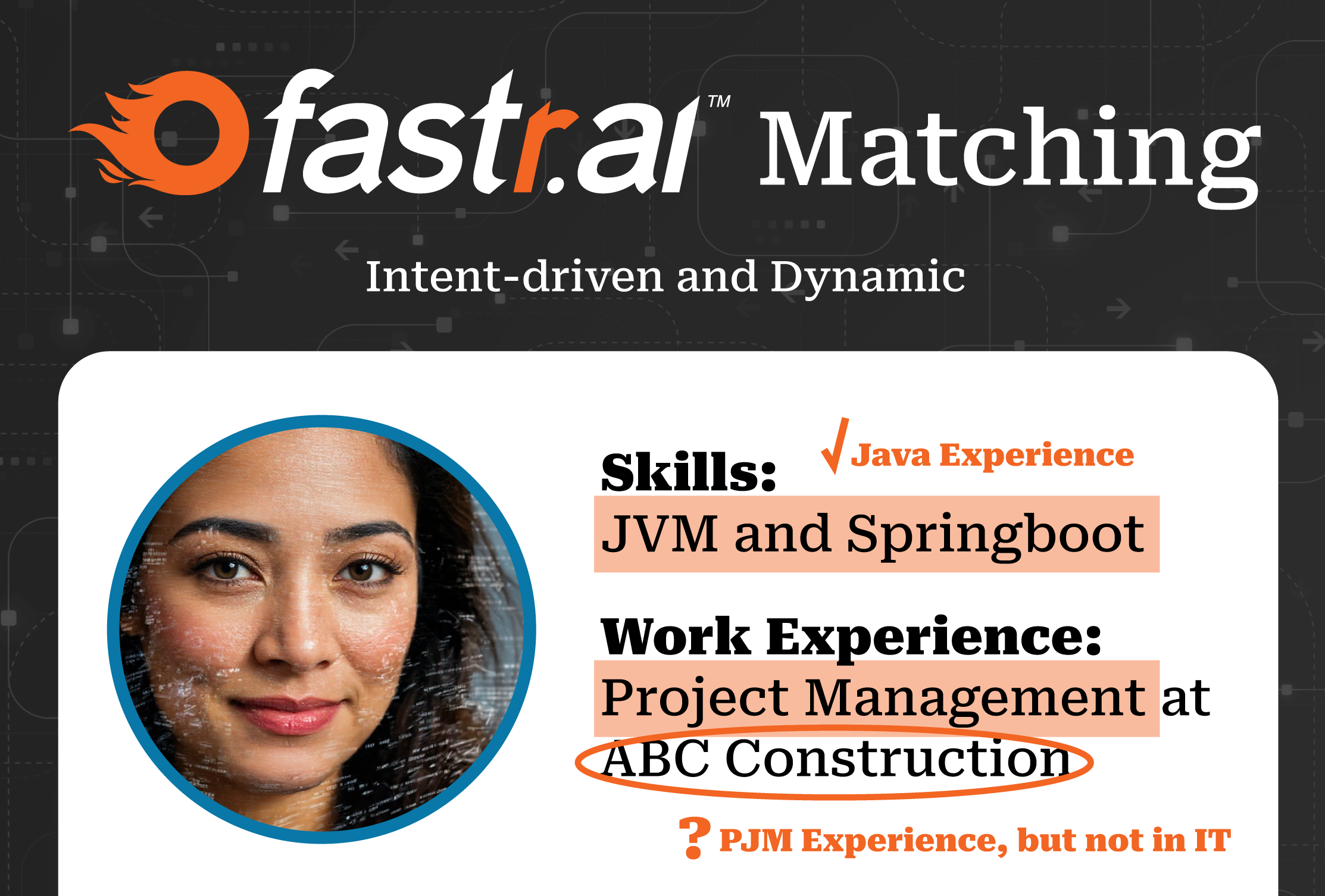
| Logic | Keyword-driven. If they don’t have “Java” on the resume, they don’t exist. | Intent-driven. Understands that “JVM” or “Spring Boot” implies Java expertise. |
| Context | Static. Treats a “Project Manager” in construction the same as one in IT. | Dynamic. Analyzes the entire career trajectory to understand the flavor of the experience. |
| The Result | A list of people who used the right words. | A short-list of people who can actually do the job. |
Why Keyword Matching is a Trap
Imagine you’re looking for a “Chef de Cuisine.” A standard search tool looks for those three words. It might miss a “Head Chef” with ten years of experience at a Michelin-star restaurant simply because their title was slightly different.
This is the Semantic Gap. Humans naturally bridge this gap; traditional software doesn’t. This is why recruiters spend hours “sourcing”—they are manually doing the translation work the software is incapable of doing.
From Boolean Search to Latent Semantic Matching
To bridge this gap, we have to look at the science of how we find information. Information retrieval deals with finding relevant documents or information in response to a user’s query. The core components of an information retrieval system include queries, documents, and surfacing algorithms. By framing matching as an IR task, we move into the realm of Semantic Search. In this model:
- The Query: The Job Description (JD), often an unstructured, “noisy” document.
- The Document: The Candidate Profile, a heterogeneous mix of chronological experience and skills.
- The Prioritization Function: The engine that must calculate the “relevance score” between these two high-dimensional entities.
The Challenge of Document Representation
Turning a complex human career into a mathematical vector is non-trivial. Standard systems struggle with Semantic Ambiguity (a “Project Manager” in construction vs. software) and Information Asymmetry (JDs are “wish lists,” while resumes are “histories”).
Most AI tools only read the first page of a resume. If a candidate’s most relevant achievement is buried on page three of a long, successful career, it gets ignored. This “truncation” is why your team often misses senior talent who didn’t optimize their CV for a machine.
*Technical Deep Dive: Dense Representations & ChunkFusion
We move beyond Sparse Representations (like TF-IDF or BM25) toward Dense Representations. To solve the “Long Context” problem—where long resumes exceed the ~512-token limit of standard Transformers—we use a two-stage Transformer + ChunkFusion architecture. We introduced a modified Transformer architecture, with changes which allowed us to arbitrarily increase the length of the context window of the model.
Overcoming the Challenges of IR Matching
Representing matching as IR introduces three specific engineering hurdles:
1. The Semantic Gap & Knowledge Graphs
Ambiguity is the enemy of precision. If a JD asks for “Python” and a resume lists “Django” and “Flask,” a basic IR system sees a mismatch. We eliminate the “keyword lottery” by understanding that these skills are part of the same ecosystem.
*The Tech: We integrate Knowledge Graphs (KGs) and Ontologies. By mapping relationships between skills, we can infer competency even when exact keywords are missing.
2. Modeling Latent Preferences
In matching, “relevance” is subjective. A hiring manager’s preference for a specific industry background is often an unstated bias.
*The Tech: Traditional Learning to Rank algorithms must be adapted to account for multi-objective optimizations—balancing technical fit with “soft” constraints.
3. The Precision-Recall Tension
In high-volume recruiting, a system with high Recall (finding everyone who is qualified) often suffers from low Precision (including many who aren’t). Conversely, overly strict filters miss “diamond-in-the-rough” candidates.
*The Tech: We don’t analyze matching as simple binary “good” or “bad.”. Instead, we represent candidate relevancy as a continuous variable, calibrated by human recruiters. This reduces “false positives,” saving recruiters hours of manual screening.
The Fastr.ai Approach: Precision at Scale
Fastr.ai has engineered a proprietary pipeline designed to solve these specific IR bottlenecks. Our methodology centers on two core pillars:
Neural Prioritization & Dense Transforms
Fastr.ai has engineered a proprietary pipeline designed to solve these specific IR bottlenecks by combining Neural Prioritization with Structured Ontologies. Unlike traditional methods that lose nuance, our methodology ensures that “Compactness” does not come at the expense of “Context.”
- Neural Prioritization & Dense Transforms: We project jobs and candidates into a shared embedding space, ensuring your recruiters spend their time talking to the top 1% of talent rather than scrolling through endless lists of “okay” matches.
- Resolving Ambiguity via Ontologies: To eliminate the “keyword lottery,” our system understands that a candidate with “Natural Language Processing” experience is a strong match for a “Machine Learning Engineer” role, even if the JD never uses the term “NLP.”
What This Means for Your Business
Why does this technical heavy lifting matter to a Head of Talent or a CEO?
- Stop Sifting, Start Talking: Your recruiters should be interviewing, not playing “Find the Keyword” for four hours a day.
- Find Hidden Talent: By understanding skills instead of just words, you access a pool of candidates your competitors are missing because their search tools are too literal.
- Reducing Friction: We provide a “relevance lens” that helps prioritize who to look at first, keeping your pipeline moving at the speed of your business.
To see our approach to information retrieval and matching in action, contact us today to schedule a demo.